My search for a cobbler in India’s sprawling capital, New Delhi, brought me to Khan Market, a shopping district with, shall we say, pretensions. Years of tramping the world with a leather satchel and a well-worn pair of walking shoes necessitated serious repairs, though there are few places left in the world that still have a quarrel with throwaway reflexes. But the bazaars of South Asia do yet reserve a place for the artisan who gives new life to leather goods.
In truth, Khan Market’s origins were friendly to my fix-it endeavor. It was born in the aftermath of South Asia’s bloody partition dividing India from Pakistan, when refugees from India’s Northwest Frontier huddled here at the edge of a newly independent city in hopes of a safe and fresh start. In time, a nearby diplomatic quarter and toney suburbs turned the market into a world-class commercial center boasting the trendiest name brands and eateries.
But there are some notable hold-outs who survive in some other dimension. A stone’s throw from the swish clientele and savvy tourists, behind some grimy car-part dealers, I found the cobbler in his niche, sitting cross-legged midst swatches of leather, his iron last, and ranks of mended shoes all sporting an impossible shine. He examined the state of my world-weary satchel, nodded and told me (for a bargain) to come back in two days. I told him he could skip the trademark shine.
Celebrating this windfall deal, I looked around for some refreshment. At the edge of a parking lot, surrounded by tuk-tuk drivers I spotted another hold-out: the chai-wallah (tea vendor) who was serving up his hot, sweet beverage to workaday bystanders. The aroma from his simmering pot told me this was more than regular chai (properly, black CTC tea with generous portions of milk and sugar). He was serving up masala chai, robust Assam tea turned to elixir by the addition of spices: mulled cardamom, ginger, peppercorn and a measure of care. And this on offer for 15 rupees a shot, less than 20 cents (US).
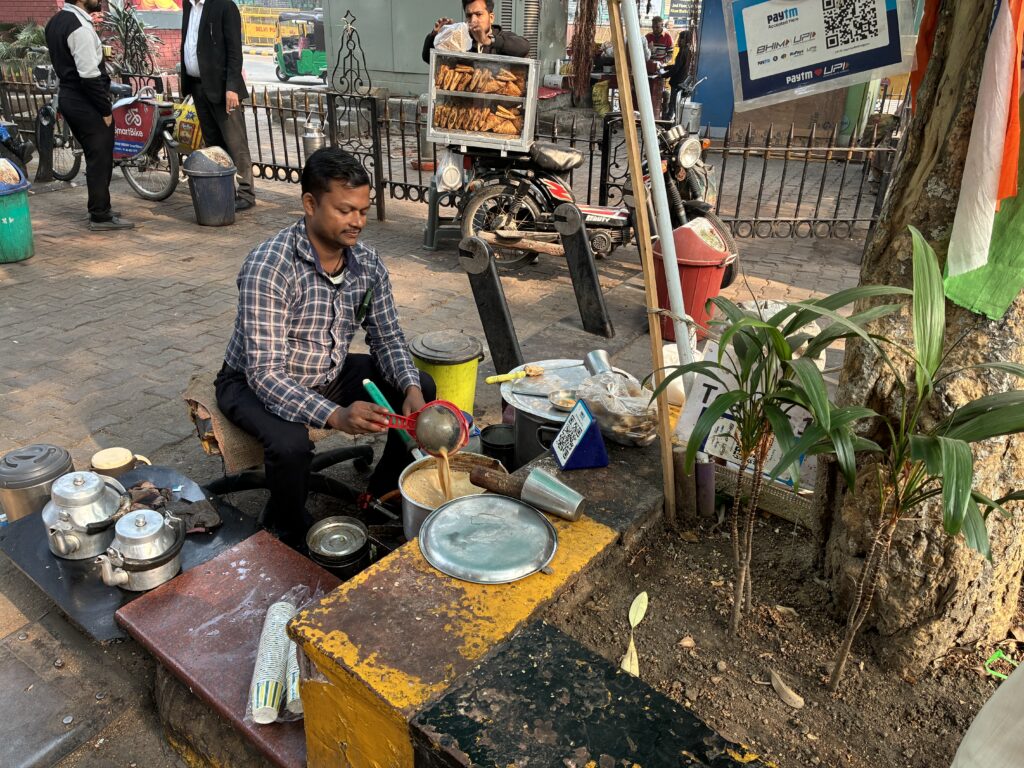
I became a repeat customer in that parking lot returning not just for the rare beverage, but for the bonhomie of those who ferry – at daily risk to their health – well-heeled customers around this, the most air-polluted city* on the planet. Surely they gather there to find levity among their peers but also, solace in the magic of the vendor’s masala chai. And all of that is served up not in designer showrooms, or the gleaming glass, bright lights and marble floors of Khan Market. Rather, it turns a corner of the homely parking lot into a world-class venue of authentic Indian culture and inspiration without a trace of pretension and unnoticed by the breathless jet-setters who pass nearby.
*During the fall and early winter months the smoke from stubble field fires, from factories and heavy transport envelope Delhi and much of north India. During our visit in late October, the Air Quality Index (AQI) was regularly in excess of 400, ‘severely polluted’.


Your way with words, Jonathan, spark our memories of breakfast soup served at a Hanoi market, dipped out of cauldrons of steaming spicy bone broth, noodles, pork fat, fresh greens and maybe it’s best not to know what else! We do know that the Pho that has become popular in the U.S. doesn’t begin to satisfy the palate like the Pho of Vietnamese markets!!
Hello, Pat! I’m afraid I’d be a rather poor judge of Pho – especially for breakfast! – but some of my fondest memories are of sharing Pho with a Dr. Tran in Atlanta who I believe you may once have known. He had once been a public health official in the port of Saigon (Ho Chi Minh City). Such a story he told of his life and his losses, but none of that prevented us from sharing a friendship. That was the seasoning in the Pho that made it memorable to me.
Thank you for sharing this Jonathan! Makes my mouth water just thinking about that Masala Chai!
Good material for contemplation – how can the poorest produce the best?
Yummm, Thanks for sharing.
Greetings from Landour .
Thanks for another good read Jonathan.
I understand that in Winter, Delhi’s AQI can be literally off the scale (over 999).
Another recent discovery is that mochis no longer like to be called that, as for various reasons, it has become a derogatory term.
Stay well!
Hello, Mark! Thanks for stopping by the masala chai story! I’m so grateful that you flagged my archaic use of ‘moh-chi’ which I have since changed to ‘cobbler’. Language gets slippery when we’re not paying attention! Such an honorable calling, too!
Beautifully written, Jonathan. I felt like I was there with you! Would love to see the refurbished satchel and shoes!
Yes – I’ll let the finished product tell the story when we get a chance. There’s something of a parable in these experiences: that however worn or tired, in the right hands, there is a fresh departure waiting to happen.
Thank you for sharing, Jonathan. I will have to visit Khan market next time I visit Delhi.