Only those who have lived in drought-stricken country can fully appreciate the stunning effect of the vision of a brimming dam. So powerful is its human effect that it can induce vertigo both of body and soul. When we went to visit such a dam in the company of a friend from the desert interior of Botswana, she strode to the crest of the barrage, took in the watery scene and sank to her knees unhinged by the vision of such an expanse of water. She retreated into silence for the rest of our outing and never spoke of it again.
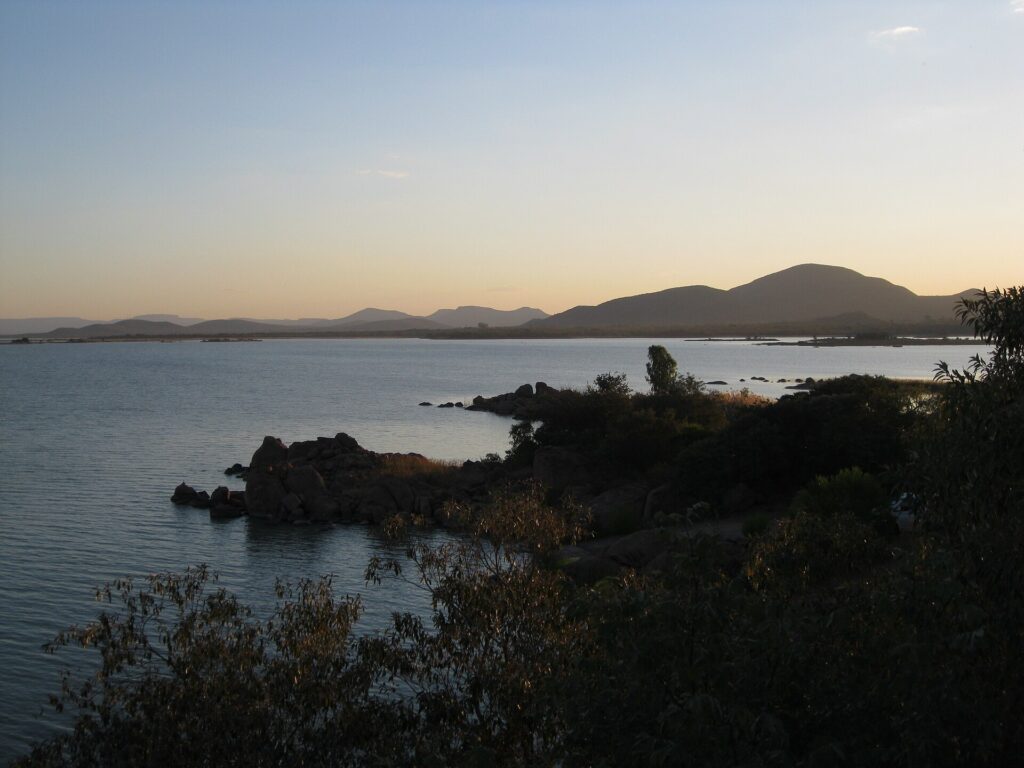
So it is that hardy and determined folk up and down the length of the Kalahari build catchments that hold back precious runoff from rains or create reservoirs of seasonal rivers. Such an engineer set about some years ago with digging out a basin and raising a dam midst rocky outcrops near the thirsty community of Francistown, Botswana. Given the project’s limited scale he toiled on his own with a bulldozer carving out a depression and building a barrier that might someday result in a life-giving reservoir.
As Christmas approached, during gritty hours on the ‘dozer, he had plotted a surprise trip with his family to visit relatives in Australia. He parked his equipment in a sheltered corner of the construction site, gathered up his children and took flight across the Indian Ocean. Somewhere in a leafy suburb of Brisbane or, perhaps, Melbourne, taken into the embrace of loved ones, they set aside all thought of the lives they’d left behind in the Kalahari thirstland.
But while they sang carols and shared seasonal delicacies, a great change overtook the interior of southern Africa. It is true that the furnace of southern summer often brings a season of rains upon which the cattle depend and that farmers rely on to grow their tentative fields of sorghum. But hardly anyone could remember such a profusion of rain as descended from the heavens that year.
In time, their Down Under holiday ended, the engineer and his family said farewells and boarded their return flight to the Kalahari. They were welcomed home by a lush landscape dotted with pools and contented herds of cattle. Arrived in Francistown, the engineer swung by his construction site, there to confront a shocking scene. A wave of vertigo left him groping for his bearings. His bulldozer was barely visible beneath a sheet of water that had settled into the reservoir of his own creation. Not even the wisest village elders could have warned him of such a danger in this desert corner of the world: that a deluge would one day rise to claim his earthmover in bone-dry country.
It was not just the sting of losing an asset that pained him, however: it was rather, that his manner had betrayed a want of hope. That heedless work and faith failed to meet, remained strangers to each other. He had toiled without expecting the very thing he wished to gain. Such are the times, say the elders, that yield the rarest of insights.
But the story does not end with soulless effort, with paltry hope, or with blunder and loss. It ends, rather, with what any desert community recognizes as scandalous gift, with what any Kalahari couple wishes impossibly for their wedding day: that the heavens should part to sluice the earth with rain, making mayhem of all outdoor processions and feasting, as a sign of unrestrained goodness, of insane promise, of a redemption that outruns human folly.
And that blessing would be worthy of lifelong vertigo.
*A romantic poet, Samuel Coleridge, authored a poem by this very name, ‘Work Without Hope’. It evokes his barrenness and exhaustion while nature buzzes with purposeful toil.
Leave a Reply