I met Rathin in Asia’s lush Brahmaputra river valley. He chauffeured the vehicle I’d reserved for a visit in secluded NE India wedged between Bangladesh, Myanmar and Tibet. There was a touch of romance in learning that his Sanskrit name, meaning ‘celestial charioteer’, hinted at the prospect of finding rare, perhaps even mythic, country in his company. He kept full faith with his name. The humble vehicle, though hampered by broken roads, led into the back country of a land renowned for its Himalayan rivers and magnificent wildlife, its blue hills and rolling tea estates, its tribal longhouses beside terraced rice fields.
Against this breath-taking backdrop, my charioteer’s personal story, like a Mughal miniature, began to etch itself into a corner of that Asian mural. Rathin’s ancestors had once lived in the delta country of Bengal, but, caught in the maelstrom of India’s Partition (1947) they had fled what later became Bangladesh. Making their way north they found a home in India’s Assam valley, though, as it happens, with none of the formalities or paper trail increasingly required by modern nation-states. Indeed, it came to light that though they were now honored neighbors in their riverside town, the authorities regarded them as stateless: they were long-since forgotten in the Bengal delta but never formally acknowledged in India.
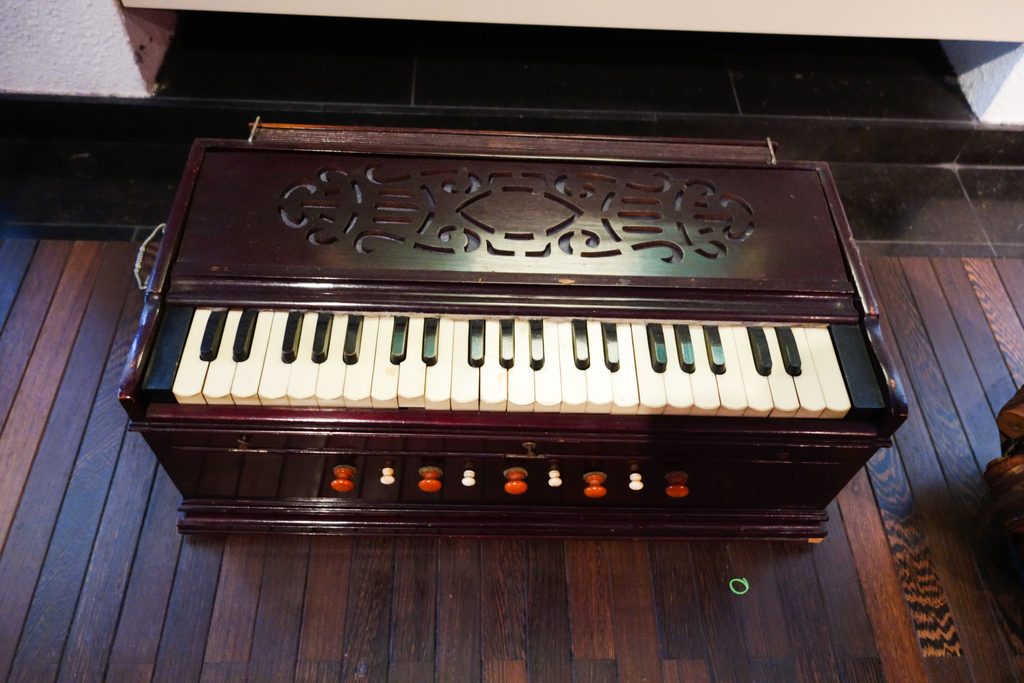
His grandfather, he said, had once been a lauded performer of ‘bhajans’ (Bhakti devotional hymns), but who had also perfected the skill of handcrafting harmoniums, a portable organ-like keyboard favored by musicians across south Asia. His instruments were so prized that he was approached by an English entrepreneur to produce them industrially. An efficient factory would make them both comfortably wealthy, he was told.
Since it was not wealth the grandfather fancied most, but rather an allegiance to some spiritual country of painstaking artistry, the old man demurred, asking, ‘Could an instrument wrought by machines ever be made to soar in sacred song?’ No, said Rathin, his grandfather was content to labor on creating by hand the harmoniums that had awed the recital halls and temples of Bengal.
His manner in recounting this story led me to believe that though in the ledgers of nation-states Rathin, too, might be stateless, he, like his grandfather, had been fully naturalized in some country of the heart; a country to which they both irrevocably belonged. Rathin allowed, as he drove his chariot through mist and hills, that he himself had no musical gift, though a certain harmonium held pride of place in the family home. But as for him, he was fully at ease on the roads leading to that other country: roads through a story that conferred on him – as on his stateless grandfather – a fierce and abiding sense of belonging.

Beautiful!
Always mesmerizing.
Hello, Barbara – I recently read a piece suggesting that beauty where we find, or even better, by luck create it, also awakens a yearning for justice. If that be true, then I am thoroughly gratified for your sentiment! Thank you for following here!
Why am I in tears at the end of this traipse through the lush Brahmaputra river valley in Rathin’s chariot?
Hi, Pat! This fellowship of tears is a rare and exquisite gift. I’m in your debt!
A beautifully written and deeply moving piece Jonathan. Rathin’s grandfather was really devoted to his art, a reminder that some things are far more valuable than wealth.