Lovers of leisure sailing watched in horror two months ago as a cruise ship ploughed a wake across the South Atlantic with an unwelcome passenger on board: hantavirus. Alarmed public health authorities forbade the ‘MV Hondius’ from entering their ports for fear of the affliction she might bring ashore. The cruise ended with a whimper as surviving passengers were airlifted by night to expert care at home.
Little did the world know that as this virus story seized the imagination of the global North, a lethal strain of Ebola virus had slipped out of its fastnesses into remote settlements of NE Congo (DRC). Unremarked for weeks it had taken a ferocious toll of those who live beyond the gaze of surveillance systems or effective counter measures, insidiously spreading at wakes for the dead as at markets, churches, clinics and workplaces.
The unhappy name attached to this strain of Ebola, ‘Bundibugyo’ (boon-dee-boo-gyo), is a small town visible from the Blue Mountains above Lake Albert. The Congo (DRC) has suffered 17 such terrifying outbreaks since this pathogen announced itself fifty years ago.
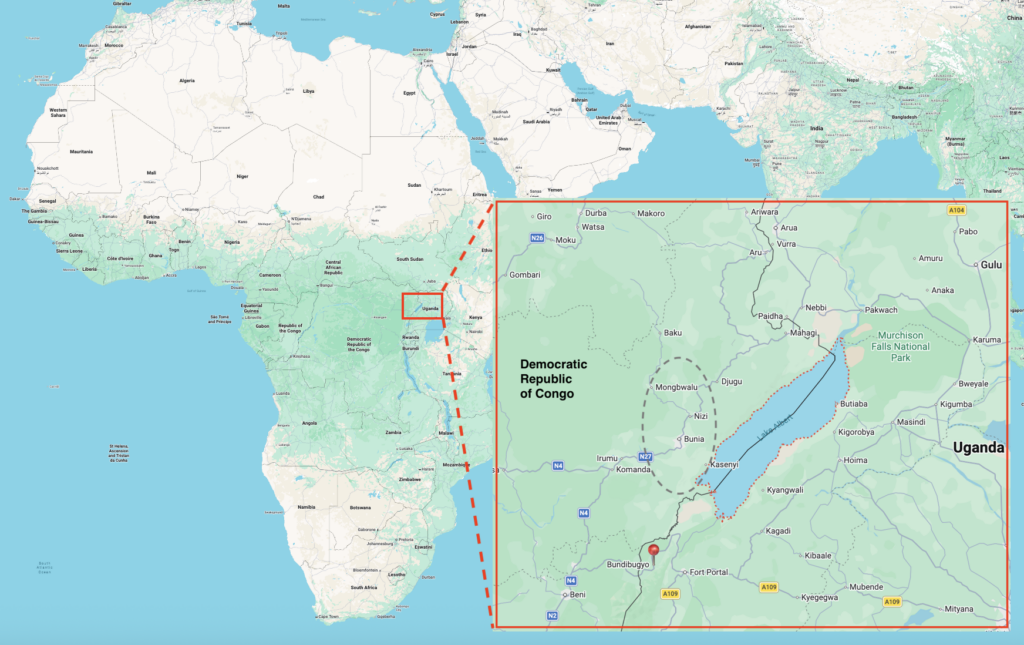
As the attention of the world has fastened upon this latest visitation, it has become clear that workers sent into the fray by plane and 4×4, kitted out in goggles and bio-hazard suits and barking through bullhorns, are facing a perfect storm of adverse conditions: rutted roads and rickety bridges, bare-bones health services, ethnic conflict, displacement camps and armed militias greedy for the riches of the area’s goldmines. In a word, they face a field of trauma. Such are the crushing misfortunes of these communities that some ask, “What offense have we committed that God cannot forgive?”
Most shocking to outsiders are images from places like Rwampara, Mongbwalu and Bunia of patient isolation tents set alight by an angry populace who have been denied the infectious bodies of deceased loved ones, a measure required to prevent spread of the virus. But local understanding that the dead, who go on living in spiritual community with survivors and who powerfully influence for good or ill succeeding generations, require that burial be accompanied by rituals to preserve harmony with the spirit world.
What is more, say some of these communities, they have been treated dismissively, left to fend for themselves for so long, what assurance is there that this sudden interest in their well-being is genuine? Is this not just another device to take advantage of those who have cheated ruin only by the skin of their teeth? The backdrop of these encounters is memories of slave trade, of colonial abuses and wars, and of having been abandoned in the post-independence era. The fires set to the isolation tents are but a vivid image of flaring resentment against those who now rule the day, however well-founded their demands might be. And meanwhile, the fate of thousands in central Africa hangs in the balance. Indeed, those fearsome pathogens could even now be descending a jetway in Stockholm, Rio, Singapore or Dallas.
But there is a small figure in this region’s story that is worth noting, a figure who came from the very environs of Bundibugyo. His name was ‘Apolo’, an itinerant African preacher who once wandered this strikingly beautiful upland a century ago. They recall his modest air, his mercy for the bereaved, his buoyant stories, his assurance to them that Heaven had not overlooked them, that there was a future for them beyond their troubles. He was beloved and he was heeded. Much of that lore is embodied in a single personal detail: Apolo came on foot and unshod, as though to say he shared and owned their misbegotten, thread-bare fates. But that they need not despair. There was yet a path to wholeness and dignity, a path that he would help them find.
His grave lies today in a small settlement called Boga, having become something of a pilgrim destination. There is a yearning for just such a barefoot emissary to return and lead the people through menace and dread to a future of assurance, dignity and strength.
*The author and his family spent three years living on the scene of the current struggle with Ebola as volunteer teachers in a normal school north of Bunia. A daughter was born to them at Nyankunde, a hospital at the heart of the present outbreak. Their former students, some now doctors, are in the midst of the current maelstrom. Medics of that earlier time spoke of poorly catalogued diseases in remote corners that resembled what are now known as highly infectious haemorrhagic fevers of viral origin.


Thank you again, Jonathan, for that inspiring reminder!
Thanks Jonathan for bringing attention to this saint–I see that we just passed the commemoration of Apolo on May 30. What an inspiring disciple!
How clever of you, Peter, to notice this commemorative date which only a handful of churches observe (Anglicans in Africa, etc.). I have recently taken to tracking such remembrances, and am often inspired by the underlying stories. (Maybe the Pennsylvanian Anabaptists will one day have a Sensenig marker on the calendar!) Though Apolo preceded the East African Revival, there is good reason to believe he was a North Star for many.
I recently read “Into the Wood Chipper: A Whistleblower’s Account of How the Trump Administration Shredded USAID,” by Nicholas Enrich. He uses the example of contrasting response to Ebola in an earlier administration with the present, when our government tossed a couple million dollars that direction without help on the ground to use it effectively.
Hello, Alice! Enrich recounts a story that – far from ‘savings’ – has come at fearsome cost, a story that we now carry with us into the future as a guidepost to steer by. Thank you for taking the trouble to be in touch.
Today’s reality is such a sad story, coupled with heroes like you describe, along with courageous and compassionate care for those who are suffering. I know Bunia fairly well because of Ted and Dana Witmer, and the theological training at Shalom, along with its hospital and medical training. I continue to wonder what difference it might have made to have US-AID present with its compassionate involvement with so many local communities.
Hello, Steve! It’s such a bracing thought to imagine you wandering the streets and markets of Bunia – though its verve will have been stolen now by the epidemic. As you say, midst these shadows, there will be written stories of unselfish giving and sacrifice. Be well, mon cher!