Casting about for a suitable Father’s Day lunch this twosome – my wife, Mary Kay, and I – wandered north of Durham, North Carolina, past farms, crossroads and second-growth forest. Somewhere out there, we said to ourselves, a diner was waiting with obliging– even if not refined – southern hospitality for such a homely occasion. In time, a promising sign directed us to a ‘Lakeside Grill’. We crested a slight rise at the parking lot, and there below us lay a toy inlet off Lake Holt kitted out with kayaks, a boat ramp and figures from central casting with fishing lines in the water by a sandy verge.
That wide beach told a sobering story. This stretch of the Carolinas – like Mauritania, Afghanistan, Ethiopia and dozens of other places – lies in the grasp of extreme drought. While birdsong still echoes, it’s as if the deeper background – the sere whisper of pines, the grating of cicadas in the summer heat, the shrunken reservoirs – suggests stress, a strain that travels silent and deep, even into the psyches and dreams of those who live here.
But we found cool refuge in the dining room where scattered others sat with scarcely festive sandwiches and sodas. Having given our orders, we asked if we might share a table with a 40-ish father and his adoring grade-school daughter. They readily agreed. With little nudging, the father began to unspool his story. He’d grown up in a neighboring town leaving a trail as the rascal who’d escaped consequences because his father sat on the town council. The public schools were moribund from neglect, and city hall had not had a single selfless or original idea for a generation or two. A kind of drought had settled on that suffocating southern town and on his own search for himself. He could think of only one way out.
Before long he found himself aboard a vessel patrolling the coasts of West Africa where he and his comrades rode a crest of adrenalin into civil war to extract diplomatic personnel from coastal cities. He chattered on about shore-leave in ports like Cape Town and Walvis Bay as though they were his own backyard. And now, though returned to civilian life, he could name frankly the sad governance of his own origins, the inability of hometown leadership to seek his, or the common, good.
His own family had not survived the churning of this story – they sat bonded as a mere twosome. But at least in calmer times, this child remained to him, a spritely and priceless gift around which to fashion a worthy life as father. Whatever else his own drought had taken from him, a treasure beyond telling, a lush and innocent recompense sat at his side.
Amazing…!
Loving surprising human story – thanks!
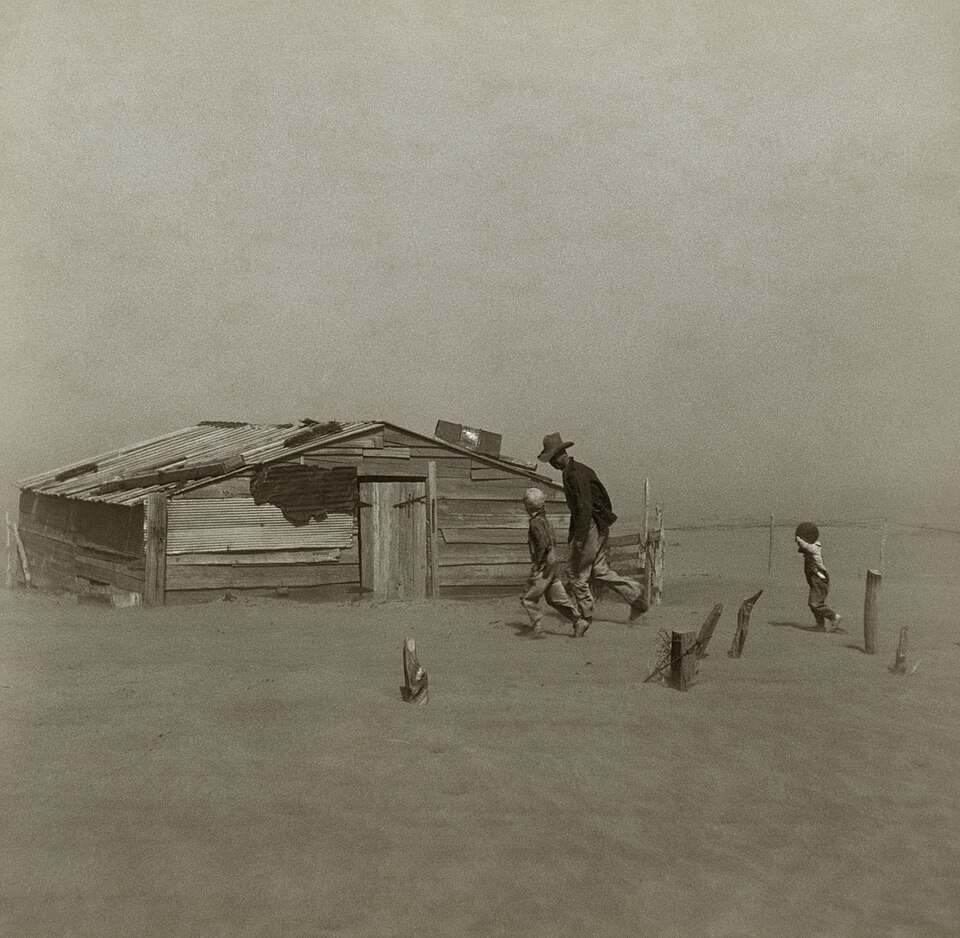
Hi, Barbara! Good of you to write! The scene of the Dust Bowl made me think of that Civil War era song, ‘Hard Times, Come Again No More’ that I’ve heard you sing.
Climate grief is but like a friend that is asking to be heard. I heard that you were writing about climate so had to look what the wise man from Durham had to share!
Thank you for reminding us that droughts can manifest in not just the environment, but also our corporate and individual souls.
Hello, Daryl! Lovely to find your note. As I studied the famous Dust Bowl image above, I felt an urge to ‘translate’ it – its grittiness, the howl of a remorseless wind, the friendless isolation, the absence of any hint of comfort – into moral terms. It’s the prophets and poets of our times who are attempting to address such a spiritual understanding of Rothstein’s photograph. Call it ‘moral meteorology’!