Before dawn on a Spring Sunday, opposing forces had formed ranks, rolling 12-pounder cannons into place as horses nickered in the darkness. Sabers and muskets clinked at the ready. It was early April, 1865 outside a Virginia village called Appomattox. The faint light fell on lines of soldiers wearied by thin rations and night marches, by shot and shell, by the indecision, folly and plain drunkenness – for good reason – of commanders. They had staggered from one battleground to another across Virginia, Tennessee, Georgia, Pennsylvania and the Mississippi Valley. And now they were ‘fought to a frazzle’. To have called this America’s ‘Civil War’ is the bitterest oxymoron of all.
Our nosey vehicle slipped into that Virginia backcountry, where, upon turning a corner, we found ourselves passing those very fields where the armies once met and where lay the half-forgotten town of Appomattox, its main street deserted in the summer heat.
Perhaps it was at the faint ringing of a church bell when the forces flung themselves headlong into the fray, but when the mayhem eased that morning, it settled on the principals that a stark sermon had been preached: that, in God’s name, this collective madness had to cease.
Storied cities around the world are celebrated as venues where peace has been struck: Paris, Rome, Versailles, Geneva. The Egyptians and Hittites fought to a peace three millennia ago at the Syrian stronghold of Kadesh. A shameful treaty was signed in Ft. Laramie between the Sioux and US federal forces. But the glamor, the diplomatic clout and history of such places – however earnest the parties – have lent little strength to the oaths sworn beneath their chandeliers.
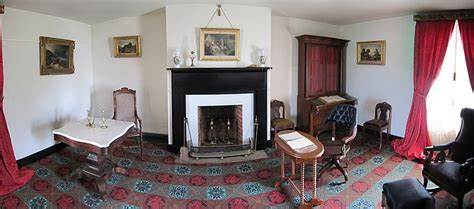
photo credit: wikipedia
That brings us to Appomattox – which has no chandeliers. Indeed, a war that had cost in excess of 600,000 dead strewn across farm fields, forests, and valleys, came to a provisional end in Wilmer McLean’s living room. McLean, a supplier of sugar, had fled northern Virginia when early battles were fought on his property outside Washington, D.C., and settled where he expected to be safely beyond the reach of the bloodshed. But after four ghastly years the war came to find him again – and then it mercifully ended midst hastily rearranged furniture in his parlor.
It’s that small detail in a humble backcountry hamlet that provokes reflection. Though the rift at the root of Civil War enmities lingers – some southerners still insist, ‘It ain’t over,’ – it’s worth asking what venue might yet offer some promise for the healing of any such stubborn fallings-out. Rather than in ornate halls of wealth and power, or behind moats and stockades, this work might well proceed in modest settlements of hard-to-pronounce names, in the parlors (literally, ‘places for conversation’) where, if necessary, the furniture has been congenially reordered that harmony might be sought. And that this give-and-take might happen before the lines of battle are drawn up in the darkness, and the aftertaste be not bitterness and remorse, but neighborly tears and a touch of sweetness.
Wilmer McLean would grant that a blessing.
Wisdom. Thanks.
I recently gained access to the wonderful PBS book “The Civil War” after having long ago watched the Ken Burn’s series it was produced in conjunction with. So am again visiting that tragedy: 600,000 lives for 3 million slaves freed only to have Reconstruction fall apart resulting in ongoing misery for former slaves as the South continues to resist. I wonder what “give and take” was possible apart from allowing slavery to continue for unknown decades.
Jonathan, thanks for continuing to treat us to your always interesting reflections on your journeys.
Hi, Gary! Your welcome note has set me to plumbing thoughts. It is naive to think that at this remove we can fully grasp the weight of events so long ago – though in some sense they are still with us. We spent some $3 trillion on a war in Afghanistan. For a tiny fraction of that, we could have equipped the country with first class schools, hospitals and clinics, changing the face of the Hindu Kush. Might it have been possible, on the brink of 1861, knowing the waste and loss that awaited, to have bought back the enslaved as a way of averting war? In some corner they must have been thinking such thoughts. The ensuing story would have taken a different course entirely. Someday we’ll have coffee in the shade of some elms – and we’ll ‘parlor’! Gracias!
Great to hear Civil War History retold with a flair of today’s English language the way Jonathan writes it! Fall Blessings from Cambridge, MN.
Hi, Barbara! For my part, I’d say, it’s a ‘groping-after’. Thanks for being such a patient reader!
If a bit of levity may be summoned of this event, 160 years later, it can be found in Thurber’s short parody, “If Grant Had Been Drinking at Appomattox.”
Yes, of course, (‘hic’) always time for levity! Let us all – including Grant who has but one boot on – unbuckle our swords and say ‘it’s over’! Well done, Mike!
Let’s offer our parlors for every small step. Thank you, Jonathan.
There’s but one fitting reply to your rejoinder, Orlando: AMEN!