Though few travelers along SW Virginia’s ‘Crooked Road’ (US Highway 58) would give more than a passing thought to its origins, the serpent-like blacktop through the hills once served as footpath to the Cherokee, long ago masters of the Blue Ridge. Their successors in the hills say that in the hush of mist, forest and mountain slope, it is still possible, of a day, to hear the echo of their hunting calls.
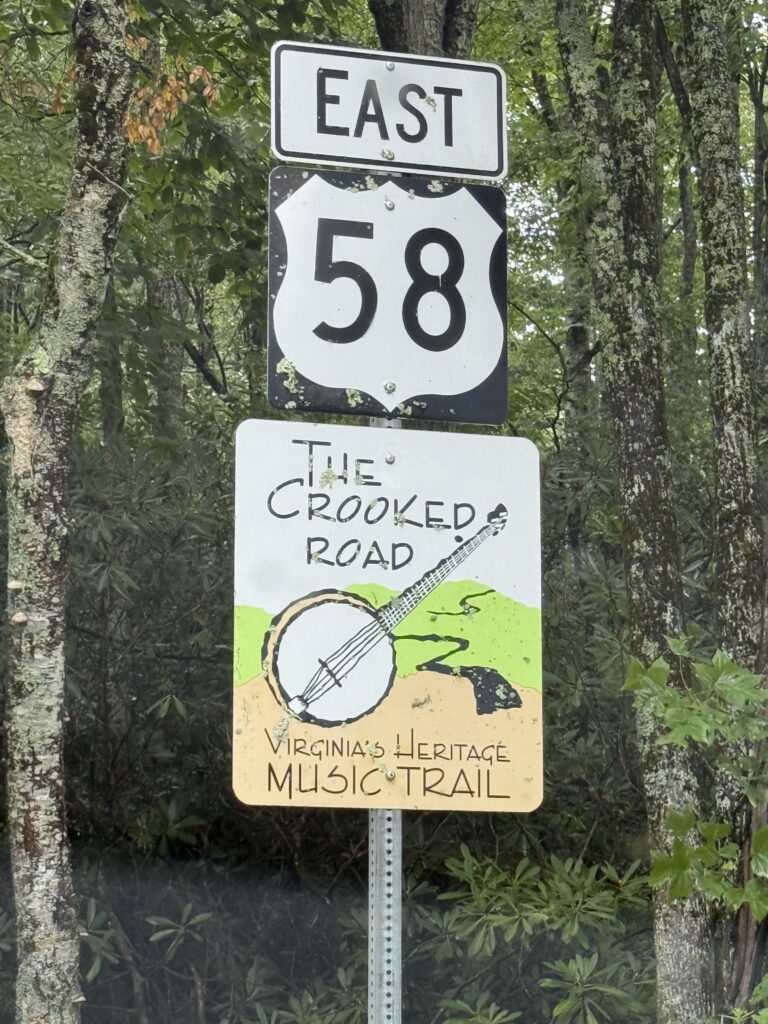
is the spine of a body of Appalachian music that ranges from
folk hymns, to ballads, to folk songs. Names attached to this
tradition include Ralph Stanley, Dock Boggs, the Carter Family
and Tennessee Ernie Ford. This music aches with yearning,
hard times, and aspiration.
Should you hear that faint summons, you might leave the uber chic town of Abingdon (VA) in your rearview mirror, give a miss to the interstate, and turn east on the ‘Crooked Road’ into the domain of the Virginia Creeper, the vines that take exuberant possession of trees, fences, rock faces and derelict shacks, turning them all into eerie, verdant creatures gathered in whispers for a summer ball. The music – sometimes thunder – rises from the thrashing streams paralleling the highway.
As the vegetation changes with rising altitude, so, too, the clues to cultural life. On the lower skirts of the hills stand the sedate and prosperous churches, those minded by seminaries and prayer books. But in the steeper sections, near the ridge tops, where the switchbacks grow ever sharper, you glimpse the clapboard of Pentecostal Holiness persuasion or of Regular Baptists. With some justification these hard-scrabble faithful, who sing by heart and pray with ecstatic tears, believe they are within earshot of the courts of heaven.
But before transporting us to that great beyond, the Crooked Road led us past road signs turned to lace by overeager marksmen to the Railroad Market and Café beneath the summit of Whitetop mountain. There in rarified air we tucked in to some of the worthiest southern biscuits found anywhere this side of glory as a little girl played hopscotch on the parquet floor. Minutes later, two fully accredited local gentlemen, one wearing a faded Mountain Dew t-shirt, settled themselves next to our booth and turned to make us outsiders feel more fully at home.
There ensued such a conversation as a hungry writer could barely dream of. It began with their lament that Whitetop wasn’t nearly as winter-white as it used to be. Climate change had claimed the snows of yesteryear, they said. When we swooned to them about the wooded mountain beauty, they insisted that the best of it was locked away in memory. The hills, they said, had once been graced by carefully tended fields and pastures. But folk had failed to mend their fences, and, in time, the tobacco, the corn and the cattle vanished. In their place there appeared tracts of ‘infernal Christmas trees.’ They had long lived off the land, they said, sharing with one another in humble if precarious self-sufficiency. Now they hardly know their neighbors except to say ‘Hi’ at the local market.
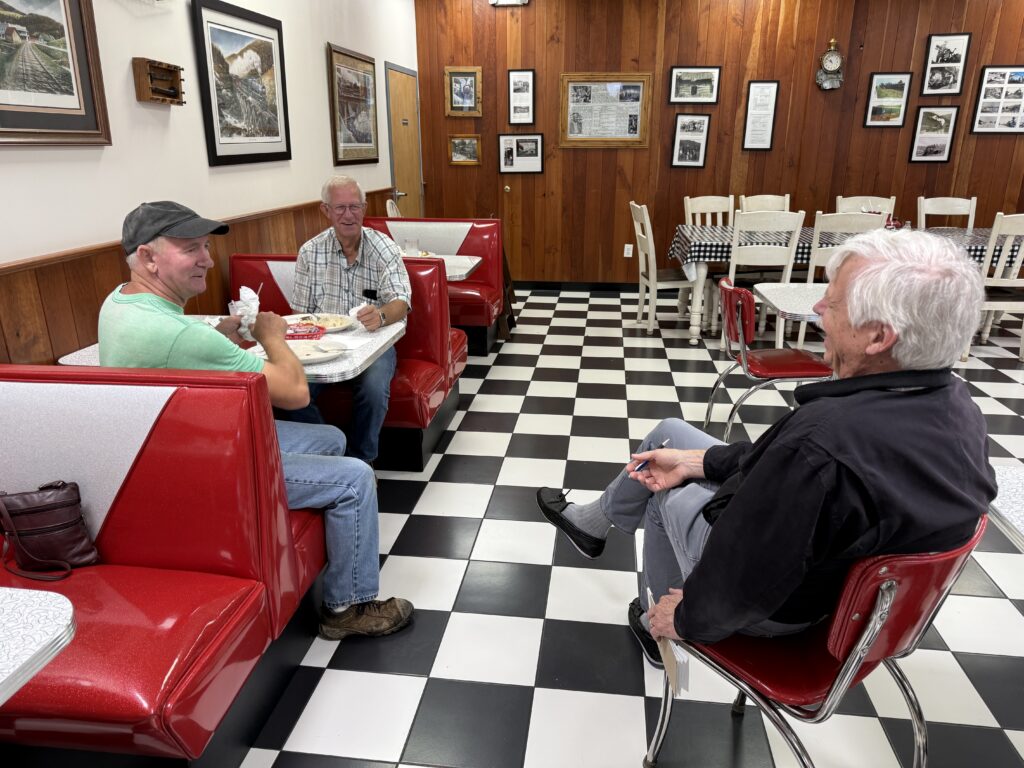
But in this case, they are seasoned with flamboyant story, outrageous turn of phrase,
and laughter, rhetorical skills born of the beauty and troubles of mountain life. The
‘Crooked Road’ brings occasional celebrities and icons to this otherwise remote
corner. Their pictures now figure on the cafe walls. The above encounter between
the author and two local customers may, itself, one day be grist for stories told in
disbelieving mountain cabins or church vestibules. It may even be occasion for a
mountain ballad. Note the author is keeping pen and pad at hand to capture the
repartee. photo credit: Mary Kay Larson
During earlier times, they continued, a famous and well-meaning woman had come to visit Whitetop – Eleanor Roosevelt – who had hoped her visit might ease their isolation and difficulties. But she failed to live up to mountain standards of grace and their circumstances had changed hardly at all. Then there was a gentle word of caution to us lowland city folk. As children they had now and again gone to visit the metropolis of Raleigh (North Carolina). They had marveled at its tall buildings and streets thronged with traffic. Why, they said, genteel drivers moved silently along the streets with hardly any honking. Now days, they countered, the streets of Raleigh are scarcely recognizable, full as they are of the din of irate drivers who blare their horns all day long.
We bid them a grateful fare-thee-well and crept sedately away without a sound. A single image lodged with me as we descended towards the lowlands: that of a modest white cottage facing a horizon of hills. The porch held a swing for two and a sofa that had seen better days. From that perch the eye settles on the majesty of cloud and mountain ridge. Is it any wonder that from such humble spots as that, sometimes sung in ‘high-lonesome’ or intoned as spiritual, sometimes buoyed by mandolin and fiddle, there has arisen the plaintiff beauty of folk ballads like this:
I’m just a poor, wayfarin’ stranger,
A travelin’ through this world of woe.
But there’s no sickness, toil nor danger,
In that bright land to which I go.
It’s always comforting to hear and learn from local voices without the constant noise of politics!
Hello, Matius! Yes – as I’m sure you’re finding in quiet corners of Lombok! For us, it was a strain to follow the rise and fall of melody in the mountain accent. And they confessed that our citified speech took work to understand. To have bridged that divide gave great satisfaction – an exercise in becoming a humane soul.
Thanks, Jonathan. Living near the Smokies and mountain roads and towns, I really appreciated this edition of Traipse.
Salutations, Jim and all! We actually had the notion that you might come sashaying through the doors to join us! The biscuits alone would have been worth the mountain miles!
Been there, love that! Thanks!
Hello, neighbor Barbara! It’s yours to sing that closing ballad! Why am I not surprised to hear you may have been in that very cafe, and possibly making music with the twosome who met us there? Storm Helene took with it so many bridges, homes and vulnerable souls, but not the verve of those who survived and live to turn trouble into melody.
Jonathan,
Thanks for the song of the mountains. I still live right here. Monica
Hi, Monica! So glad to find your lines here. These are people and places that you know intimately. I suspect your footprints are all over Whitetop. Had we stayed long enough in the cafe, eventually there would have been a wistful story about you! Be well!
Thank you, Jonathan. You keep outdoing yourself!
Greetings, Orlando! Good of you to send your line of response! I have the sneaking suspicion that like storm-tossed driftwood, stories are at their best when they come to find you; are soulful and radiant not so much by skill of the teller, but by the long journeys they have come to land at your feet. I would not be the first to say that the enduring and greatest task of the teller is to pay attention, to be wakeful.
Thank you for this. We love traveling through these parts on our way to Atlanta to visit our son. Mountains have always held my heart.
Hello, Joie! Your response reminds me of a saying I once heard. There are those who live in the mountains as though they lived on the plains. But there are those who live on the plains as though they lived in the mountains. To take the mountains with us on to the flatlands of life, that’s extraordinary! Thanks for stopping by the blog. And happy trails!
I love this piece, Jonathan. We’ve been there a couple of times. I can well imagine the conversation.
Hello, John! Might I have spotted and heard you on one of those melodious porches? Thanks for your message!
I love this story, Jonathan. I especially like how your framed the history and how things change over the years, decades, centuries…
Did the locals actually name climate change as the reason for the warming of their valley?
Hi, Shirley! ‘Climate change’ was my interpretation – my recollection is they talked about’these warming winters.’ I’m guessing the underlying issue might be, ‘To what extent is climate change recognized/acknowledged by mountain communities?’ That would require some serious inquiry to establish. I’d love to know the findings! I suspect your vantage point in the Shenandoah would give you some impressions of an answer. Thanks for writing!