Mary Kay and I shouldered our bags at the handy youth hostel and walked out of central Geneva (Switzerland) looking for an east-bound ride. There on the north shore of Lac Léman a kindly Swiss forester paused to pick us up on our way into the wintry Jura Mountains. As we sailed past manicured farms and towns, past glimpses of the lake and through tunnels, our friend gave testimony of the great wager he had made with his life: the care and preservation of forests. He rhapsodized about the shelter they afforded from winter avalanches, about their quiet beauty and the home they provided for wildlife, about how much they had shaped his own, and Swiss, identity. Somewhere near Neuchatel, we bid each other farewell as he left us with this solemn charge, ‘Wherever you go, do not fail to plant trees.’
Having made our way as far as Tramelan, we called the innkeeper of our lodge, Les Mottes, to tell him that we were now in range, asking that he come to collect us for the remaining few miles. In short order, Daniel Gerber found us curbside and brought us to the retreat center where we joined fellow volunteers preparing to teach school in Africa. Between rope-lift skiing, visits to fromageries where wheels of cheese aged happily on spruce planks, and suppers of fondu, Daniel told the following story. His Anabaptist ancestors (see photo caption) had, four centuries earlier, fled persecution to find refuge in the Jura mountains and forests. Even there, they had to be secretive in the practice of their faith, resorting to caves and clearings in the woods away from the notice of authorities.
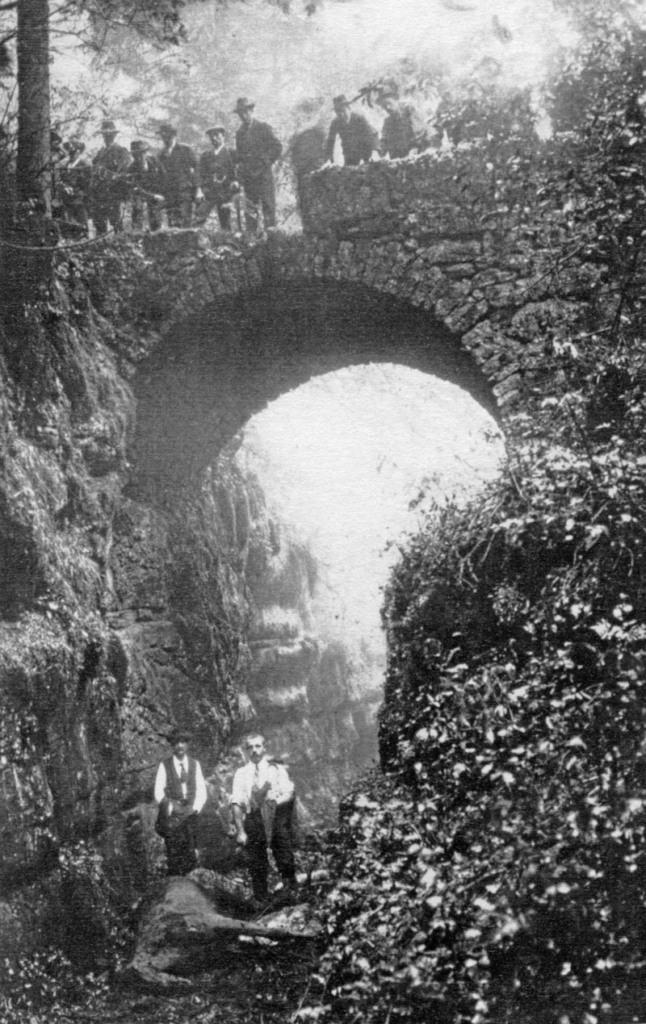
in the Jura mountains not far from Bern, Switzerland.
The gorge served as a ‘hush hollow’ where Anabaptists
(also known as the Swiss Brethren) as far back as the
17th cent. met to worship in secret. They taught
separation from state religion and sought to pattern
their lives after Jesus’ Sermon on the Mount. The
picture (from 1918) documents a fatal mishap of a
horse and rider fallen from the bridge, which has since
collapsed. (photo credit:Fritz Tschanz)
In these simple gatherings far from city cathedrals, he said, the faithful required little. A Bible and a small table to share communion would suffice. But such a table spotted along mountain trails would be easily recognized by the police even when hidden under canvas in a cart. A cabinet maker in the circle, however, offered a clever solution. He would craft a table, he proposed, that might be easily disassembled. The individual pieces – frame, legs, leaves – innocent by themselves, would be distributed to the faithful who could bring the parts to the appointed meeting ground without arousing any suspicion. There they would be assembled for their solemn purpose and then be safely carried home.
In time, said Daniel, this artful creation began to take on a life and meaning of its own. It began to breathe out a quiet witness that each member of the community possessed an irreplaceable spiritual gift, too. That even in the face of adversity it is possible to find a path for faith. That absence deprives the community of a wholeness it yearns for. That what is sacred and beautiful arises not from station in life, but in the participation of all. That wherewithal for faithfulness can be fashioned, supplied by ordinary human hands. Upon such a table, said Daniel, even in the wilderness, simple provisions become a banquet.
For decades, we have pondered this scrap of hitch-hiker spirituality, found inspiration in its homely contours. It recalls a promise described by sages and seers from ancient times. That somewhere in a safe and sheltered place, midst majestic surroundings – not unlike a cathedral of mountain firs – there will one day gather a vast, appointed throng such as humankind has awaited for generations, all met in joy and tears at a banquet table for the ages.
Anywhere y’all haven’t been? (!)
Hey, there, Barbara! Well, for starters we haven’t yet made it to Mt Airy (NC) a place you know well! It’s on our bucket list. Thanks for stopping by, and for keeping score.
Great to read about your travels again! We keep on trecking with a S. Am voyage planned for Feb. A new continent for me! Blessings, Dan & Sherri
Happy trails to you both! Vayan con dios! A remarkable corner of the globe, swarming with drama, beauty and stories. We’ll find a quiet corner when you get back, and you can unpack your story satchel for us.
Love this story! I just shared it with our family. We will be traveling to Zurich, Bern, and Lucerne at Christmas time. We hope to find at least one “hush hollow” to help our children and grandchildren imagine the peril and bliss of their ancestors.
Hello, Shirley and all! Just one question: Can I come along? There is such inspiration awaiting us in these places that still whisper of lofty aspiration and perseverance. And to be bonded with one another in the experience and hearing of such stories – now, there is intimacy of a rare kind. Godspeed!
It would be fun to go to Switzerland one day! Daniel Gerber’s story was so interesting. Kevin and I have roots all over that country and know of some of our ancestors that spent time in the Jura centuries ago too. Not hard to imagine that they may have had the same experience as his family. Thanks for sharing! Safe travels!
We were among those volunteers preparing to teach in Africa (Algeria in our case) who gathered at Les Mottes in April 1971. Thanks for reawakening fond memories from that MCC retreat and the hitchhiking adventures that went along with it!
This is a great story, Jonathan. It touches me because one of the important things about the Anabaptist movement was how strongly they felt about the separation of church and state– and how they suffered under the State Church. It’s crucial to remember that now, especially as Mr 47 and his comrades seem intent on destroying that excellent principle, upon which our country was founded.
Hi, Esther! You’ve read the story with insight and a grasp of history. In his telling to us, Daniel was speaking as a witness of generations.